Running or executing Dbvisit Standby
- KrupeshD (Deactivated)
- Arjen Visser
Dbvisit Standby must be run and scheduled separately on the primary and the standby server, but the commands are the same. Dbvisit Standby will detect on which server it is running automatically. It is recommended that Dbvisit Standby is run manually in the foreground on both the primary and standby server for the first few times before it is scheduled to run automatically in the background.
Two ways to run Dbvisit Standby manually on all platforms
Dbvisit Standby can be run either from the traditional command line interface (CLI) or through a web-based interface (GUI).
The CLI commands will be indicated by 
The GUI commands wil be indicated by 
Executing Dbvisit Standby CLI commands - Windows
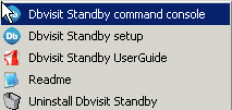
Dbvisit Standby commands are run from the Dbvisit Standby command console.
Start the Dbvisit Standby command console from the Start Menu > Programs > Dbvisit > Standby.
Executing Dbvisit Standby CLI commands - Linux/Unix
Go to the Dbvisit Standby install directory:
cd /usr/local/dbvisit/standby Executing Dbvisit Standby GUI commands – (web-based)
The Dbvserver web server must be started to execute Dbvisit GUI or web-based commands. To access the web-based GUI interface, point the browser to the IP address of the server and specify default port 8081: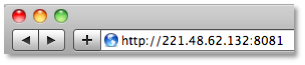
Running Dbvisit Standby on primary server
Dbvisit Standby can run as follows:
1. Execute Dbvisit Standby on the primary server:
 dbvisit <DDC>
Where DDC is the name of the Dbvisit Database Configuration. In most cases this is the same as the database name. The DDC refers to the DDC file name which is in the form: dbv_DDC.env and contains the Dbvisit Standby settings for a particular primary and standby configuration
For example:
dbvisit w102n
=============================================================
Dbvisit Standby Database Technology
dbvisit.exe started on win2003se-01
=============================================================
First time Dbvisit runs, Dbvisit installation will be copied to win2003se-02...
Transferring dbv_functions to host win2003se-02:dbv_functions
Transferring dbvisit to host win2003se-02:dbvisit
Transferring dbvisit_setup to host win2003se-02:dbvisit_setup
Transferring dbv_oraStartStop to host win2003se-02:dbv_oraStartStop
Transferring dbv_w102n.env to host win2003se-02:dbv_w102n.env
Transferring dbv_ORACLE_SID.env to host win2003se-02:dbv_ORACLE_SID.env

Contacting Standby Database w102n on win2003se-02...
Last standby sequence obtained (20).

Log file(s) for w102n will be transferred from win2003se-01 to win2003se-02...
Transferring O1_MF_1_23_380BXLVT_.ARC.gz to host win2003se-02:O1_MF_1_23_380BXLVT_.ARC.gz
Transferring O1_MF_1_24_380C0PF5_.ARC.gz to host win2003se-02:O1_MF_1_24_380C0PF5_.ARC.gz
Transferring O1_MF_1_25_382Z7S3X_.ARC.gz to host win2003se-02:O1_MF_1_25_382Z7S3X_.ARC.gz
3 Log transfer(s) to win2003se-02 for w102n completed.
Last sequence was 25.

Starting Dbvisit Archive Management Module (AMM)...
Dbvisit Archive Management Module (AMM)
(Number to keep: 0) (Days to keep: 7) (Diskspace full threshold: 80%)
Total number of archive files : 9
Number of files deleted : 0
Current Disk percent full : 39%
=============================================================
dbvisit ended on win2003se-01
=============================================================
Where w102n is the name of the database
 Home > Run > Run Interactive > Primary Server tab > select Database from drop-down menu > select Default from Run Action drop-down menu > Run
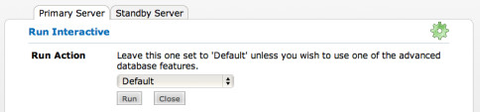
Note
- The first time that Dbvisit Standby executes, the Dbvisit Standby installation and configuration files will be copied over to the standby server. This is equivalent to running Dbvisit Standby with the -c option, or Copy Software from the Run Action menu on the Run Interactive web-based interface screen.
- The first time Dbvisit Standby executes, the standby database must be up and running because Dbvisit Standby has to determine which initial log is needed for the standby database. Subsequent times Dbvisit Standby executes on the primary server the standby database does not need to be up and available.
- In the examples the Dbvisit Standby Archive log Management Module (AMM) is turned on. This can be turned off by setting ARCHSOURCE_MANAGEMENT=N for the primary server and ARCHDEST_MANAGEMENT=N for the primary server in the DDC file, or by updating this parameter directly via the following menu path in the web-based interface: Home > Setup > Update Dbvisit > Update Dbvisit Configuration.
Subsequent times that Dbvisit Standby executes, the Dbvisit Standby installation will not be copied over to the standby server and Dbvisit Standby will NOT contact the standby database. The standby database does not have to be available to transfer the archive log files to the standby database.
 For example:
dbvisit w102n
=============================================================
Dbvisit Standby Database Technology
dbvisit.exe started on win2003se-01
=============================================================

Performing Oracle Checkpoint.
Waiting for 3 seconds for checkpoint completion...
Checking Dbvisit installation differences between win2003se-01 and win2003se-02…
No Dbvisit installation differences found between win2003se-01 and win2003se-02.

Log file(s) for w102n will be transferred from win2003se-01 to win2003se-02...
Transferring O1_MF_1_27_3839D3YR_.ARC.gz to host win2003se-02:O1_MF_1_27_3839D3YR_.ARC.gz
1 Log transfer(s) to win2003se-02 for w102n completed.
Last sequence was 27.

Starting Dbvisit Archive Management Module (AMM)...
Dbvisit Archive Management Module (AMM)
(Number to keep: 0) (Days to keep: 7) (Diskspace full threshold: 80%)
Total number of archive files : 10
Number of files deleted : 0
Current Disk percent full : 39%
=============================================================
dbvisit ended on win2003se-01
=============================================================
Where w102n is the name of the database
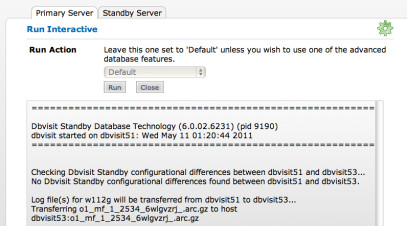
 For example:
Running Dbvisit Standby on the standby server
2. Execute Dbvisit Standby on the standby server:
 dbvisit <DDC>
Where DDC is the name of the Dbvisit Database Configuration. In most cases this is the same as the database name. The DDC refers to the DDC file name which is in the form: dbv_DDC.env and contains the Dbvisit Standby settings for a particular primary and standby configuration.
For example:
dbvisit w102n
=============================================================
Dbvisit Standby Database Technology
dbvisit.exe started on win2003se-02
=============================================================

Log file(s) for w102n from win2003se-01 will be applied to win2003se-02...
200902271142 - Log seq 21 applied to standby database w102n.
200902271142 - Log seq 22 applied to standby database w102n.
200902271142 - Log seq 23 applied to standby database w102n.
200902271142 - Log seq 24 applied to standby database w102n.
200902271142 - Log seq 25 applied to standby database w102n.

Starting Dbvisit Archive Management Module (AMM)...
Dbvisit Archive Management Module (AMM)
(Number to keep: 0) (Days to keep: 8) (Diskspace full threshold: 80%)
Total number of archive files : 11
Number of files deleted : 0
Current Disk percent full : 39%
=============================================================
dbvisit ended on win2003se-02
=============================================================
Where w102n is the name of the database
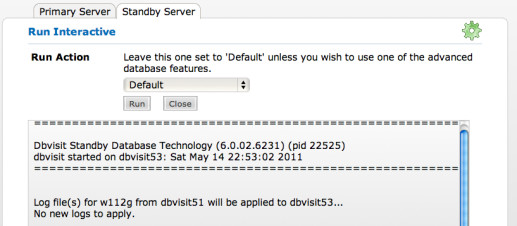
 Home > Run > Run Interactive > Standby Server tab > select Database from drop-down menu > select Default from Run Action drop-down menu > Run
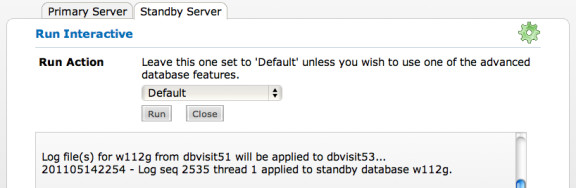
If there are no logs to be applied then Dbvisit Standby will indicate this.
 For example:
dbvisit w102n
=============================================================
Dbvisit Standby Database Technology
dbvisit.exe started on win2003se-02
=============================================================

Log file(s) for w102n from win2003se-01 will be applied to win2003se-02...
No new logs to apply.
=============================================================
dbvisit ended on win2003se-02
=============================================================
Where w102n is the name of the database
 For example:
To delay the application of the logs to the standby database, the setting APPLY_DELAY_LAG_MINUTES can be used. This creates a lag time in minutes between the archiving of a redo log at the primary database and the application of the log on the standby database. The archive logs are still transferred to the standby server as normal without delay.To turn off APPLY_DELAY_LAG_MINUTES, set to 0. See Dbvisit Standby configuration variables (DDC) for more details.
3. Manually copy the Dbvisit Standby installation to the standby server. This option can only be given on the primary server.
 dbvisit -c <DDC> [nocksum]
Where DDC is the name of the Dbvisit Database Configuration. In most cases this is the same as the database name. The DDC refers to the DDC file name which is in the form: dbv_DDC.env and contains the Dbvisit Standby settings for a particular primary and standby configuration. nocksum is optional and if specified no checksum comparison will be done between the original file or program and the transferred file or program.
For example:
dbvisit -c w102n
=============================================================
Dbvisit Standby Database Technology
dbvisit.exe started on win2003se-01
=============================================================
Transferring dbv_functions to host
win2003se-02:dbv_functions
Transferring dbvisit to host
win2003se-02:dbvisit
Transferring dbvisit_setup to host
win2003se-02:dbvisit_setup
Transferring dbv_oraStartStop to host
win2003se-02:dbv_oraStartStop
Transferring dbv_w102n.env to host
win2003se-02:dbv_w102n.env
Transferring dbv_ORACLE_SID.env to host
win2003se-02:dbv_ORACLE_SID.env
=============================================================
dbvisit ended on win2003se-01
=============================================================
Where w102n is the name of the database
 Home > Run > Run Interactive > Primary Server tab > select Database from drop-down menu > select Copy Software from Run Action drop-down menu > Run
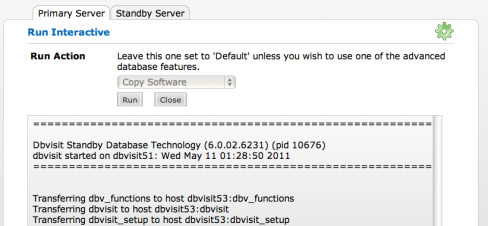
If configuration changes are made to the database Configuration file (DDC), Dbvisit Standby will automatically detect this and update the standby server (next time Dbvisit Standby executes on the primary server), if setting SYNCH_DBVISIT_INSTALL=Y. This is the default setting.
4. Manually copy the Dbvisit Standby installation from the standby server to the primary server. This option is only possible through the command line, as this functionality is not included in the web-based interface.
 dbvisit -ReverseCopy <DDC>
Where DDC is the name of the Dbvisit Database Configuration. In most cases this is the same as the database name. The DDC refers to the DDC file name which is in the form: dbv_DDC.env and contains the Dbvisit Standby settings for a particular primary and standby configuration.
This option can be used if configuration changes have been made on the standby server and these should be copied to the primary server. The whole Dbvisit Standby installation will be transferred and the Dbvisit Standby installation on the primary server will be overridden.This option can be used to test the transfer mechanism between the standby and primary server, where the standby server initiates the transfer instead of the primary server.
5. Resend a particular log.
 dbvisit -r sequence_number <DDC>
Where DDC is the name of the Dbvisit Database Configuration. In most cases this is the same as the database name. The DDC refers to the DDC file name which is in the form: dbv_DDC.env and contains the Dbvisit Standby settings for a particular primary and standby configuration.
Where sequence_number is a log sequence number. For more information see the Resending (archive) logs section.
For example:
dbvisit -r 27 w102n
=============================================================
Dbvisit Standby Database Technology
dbvisit.exe started on win2003se-01
=============================================================

Performing Oracle Checkpoint.
Waiting for 3 seconds for checkpoint completion...
Checking Dbvisit configurational differences between win2003se-01 and win2003se-
02...
No Dbvisit configurational differences found between win2003se-01 and win2003se-
02.

Log file(s) for w102n will be transferred from win2003se-01 to win2003se-02...
Transferring O1_MF_1_27_3839D3YR_.ARC.gz to host win2003se-02:O1_MF_1_27_3839D3YR_.ARC.gz
Transferring O1_MF_1_28_3839JCMK_.ARC.gz to host win2003se-02:O1_MF_1_28_3839JCMK_.ARC.gz
Transferring O1_MF_1_29_3839OYTC_.ARC.gz to host win2003se-02:O1_MF_1_29_3839OYTC_.ARC.gz
200902271152 - 3 Log transfer(s) to win2003se-02 for w102n completed.
Last sequence was 29.

Starting Dbvisit Archive Management Module (AMM)...
Dbvisit Archive Management Module (AMM)
(Number to keep: 0) (Days to keep: 7) (Diskspace full threshold: 80%)
Total number of archive files : 12
Number of files deleted : 0
Current Disk percent full : 39%
=============================================================
dbvisit ended on win2003se-01
=============================================================
Where w102n is the name of the database
 Home > Run > Run Interactive > Primary Server tab > select Database from drop-down menu > select Resend Sequence from Run Action drop-down menu > Run
Enter a sequence number.
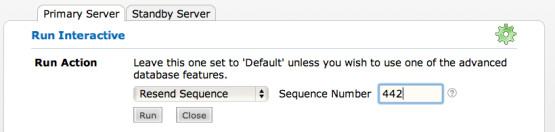
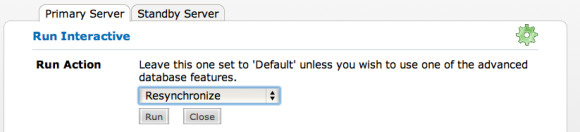
6. Resynchronise with the standby database. This is used when the standby database has been rebuilt or Dbvisit Standby is not transferring the correct archive log sequence for the standby database.
 dbvisit -R <DDC>
Where DDC is the name of the Dbvisit Database Configuration. In most cases this is the same as the database name. The DDC refers to the DDC file name which is in the form: dbv_DDC.env and contains the Dbvisit Standby settings for a particular primary and standby configuration. For more information see the Re-synchronizing with the standby database section.
For example:
dbvisit -R w102n
=============================================================
Dbvisit Standby Database Technology
dbvisit.exe started on win2003se-01
=============================================================

Performing Oracle Checkpoint.
Waiting for 3 seconds for checkpoint completion...
Resynch option given. Dbvisit installation will be copied to win2003se-02...
Transferring dbv_functions to host win2003se-02:dbv_functions
Transferring dbvisit to host win2003se-02:dbvisit
Transferring dbvisit_setup to host win2003se-02:dbvisit_setup
Transferring dbv_oraStartStop to host win2003se-02:dbv_oraStartStop
Transferring dbv_w102n.env to host win2003se-02:dbv_w102n.env
Transferring dbv_ORACLE_SID.env to host win2003se-02:dbv_ORACLE_SID.env

Contacting Standby Database w102n on win2003se-02...
Last standby sequence obtained (26).

Log file(s) for w102n will be transferred from win2003se-01 to win2003se-02...
Transferring O1_MF_1_26_383922G5_.ARC.gz to host win2003se-02:O1_MF_1_26_383922G5_.ARC.gz
Transferring O1_MF_1_27_3839D3YR_.ARC.gz to host win2003se-02:O1_MF_1_27_3839D3YR_.ARC.gz
Transferring O1_MF_1_28_3839JCMK_.ARC.gz to host win2003se-02:O1_MF_1_28_3839JCMK_.ARC.gz
Transferring O1_MF_1_29_3839OYTC_.ARC.gz to host win2003se-02:O1_MF_1_29_3839OYTC_.ARC.gz
Transferring O1_MF_1_30_3838NWTC_.ARC.gz to host win2003se-02:O1_MF_1_30_3838NWTC_.ARC.gz
200901271134 - 5 Log transfer(s) to win2003se-02 for w102n completed.
Last sequence was 30.

Starting Dbvisit Archive Management Module (AMM)...
Dbvisit Archive Management Module (AMM)
(Number to keep: 0) (Days to keep: 7) (Diskspace full threshold: 80%)
Total number of archive files : 13
Number of files deleted : 0
Current Disk percent full : 39%
=============================================================
dbvisit ended on win2003se-01
=============================================================
Where w102n is the name of the database
 Home > Run > Run Interactive > Primary Server tab > select Database from drop-down menu > select Resynchronize from Run Action drop-down menu > Run
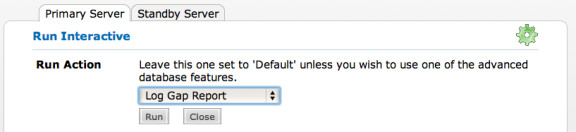
7. To determine the archive log gap, and the transfer log gap, run Dbvisit Standby with the Inspect option.
 dbvisit -i <DDC>
Where DDC is the name of the Dbvisit Database Configuration. In most cases this is the same as the database name. The DDC refers to the DDC file name which is in the form: dbv_DDC.env and contains the Dbvisit Standby settings for a particular primary and standby configuration.This produces the Dbvisit Standby log gap report. For more information, please see the Dbvisit Standby log gap report section.
For example:
dbvisit -i w102n
=============================================================
Dbvisit Standby Database Technology
dbvisit.exe started on win2003se-01
=============================================================

Contacting Standby Database w102n on win2003se-02...
Last standby sequence obtained (26).

Dbvisit report:
-------------------------------
Standby database on win2003se-02 is at sequence: 26
Primary database on win2003se-01 is at log sequence: 29
Primary database on win2003se-01 is at archived log sequence: 28
Dbvisit last transfer log sequence: 28

Archive log gap: 2
Transfer log gap: 0
=============================================================
dbvisit.exe ended on win2003se-01
=============================================================
Where w102n is the name of the database
 Home > Run > Run Interactive > Primary Server tab > select Database from drop-down menu > select Log Gap Report from Run Action drop-down menu > Run
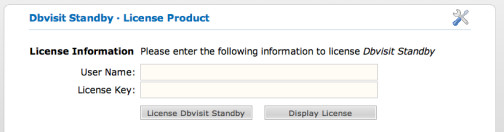
8. To view or set the Dbvisit Standby license.
 dbvisit -lic <DDC>
Where DDC is the name of the Dbvisit Database Configuration. In most cases this is the same as the database name. The DDC refers to the DDC file name which is in the form: dbv_DDC.env and contains the Dbvisit Standby settings for a
For more information see the Setting and viewing the Dbvisit Standby license key section. Home > Setup > Register
9. Help and copyright information is available if Dbvisit Standby is run without parameters or options.
 dbvisit
For example:
NAME
Dbvisit - Oracle Standby Database Technology
Automated Standby Database.
VERSION
Version 6.0
USAGE
dbvisit ORACLE_SID
dbvisit -r SEQUENCE_NUMBER ORACLE_SID
dbvisit -R ORACLE_SID
dbvisit -i ORACLE_SID
dbvisit -c ORACLE_SID [nocksum]
dbvisit -ReverseCopy ORACLE_SID
dbvisit -lic ORACLE_SID
dbvisit -lic ORACLE_SID LICENSED_USER LICENSE_KEY
dbvisit -?
dbv_oraStartStop start ORACLE_SID
dbv_oraStartStop stop ORACLE_SID
dbv_oraStartStop open ORACLE_SID
dbv_oraStartStop status ORACLE_SID
dbv_oraStartStop activate ORACLE_SID [Yes]
dbv_oraStartStop switchover ORACLE_SID [UNIQUE_KEY]
dbv_oraStartStop -?
dbvisit_setup
Lowercase/Mixed Case is Dbvisit key word.
UPPERCASE is user supplied value.
[] is optional.
DESCRIPTION
Dbvisit fully automates the Oracle Standby Database
…
Stopping and starting databases
Dbvisit Standby includes commands to stop and start the databases. Dbvisit Standby will determine if the database is a primary or a standby database and will stop and start it accordingly. It can also open the standby database in read-only mode for reporting purposes.
10. To start a regular or standby database use:
 dbv_oraStartStop start <DDC>
Where DDC is the name of the Dbvisit Database Configuration. In most cases this is the same as the database name. The DDC refers to the DDC file name which is in the form: dbv_DDC.env and contains the Dbvisit Standby settings for a particular primary and standby configuration.
For example to start a standby database:
dbv_oraStartStop start w102n
======================================================
Dbvisit Standby Database technology
dbv_oraStartStop started on dbvisit12
======================================================

Starting Standby Database w102n...
Standby Database w102n started.

======================================================
dbv_oraStartStop ended on dbvisit12
======================================================
Where w102n is the name of the database.
Example to start a normal database:
dbv_oraStartStop start w102n
======================================================
Dbvisit Standby Database technology
dbv_oraStartStop started on dbvisit11
======================================================

Starting regular Database w102n...
Regular Database w102n started.

======================================================
dbv_oraStartStop ended on dbvisit11
======================================================
Wherew102n is the name of the database.
 Home > Run > Run Interactive > Primary Server tab > select Database from drop-down menu > select Start Database from Run Action drop-down menu > Run
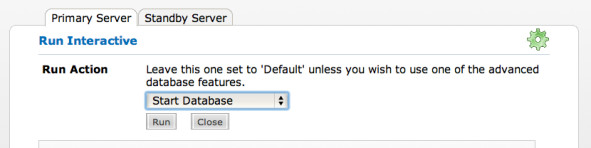
 To start the standby database, choose the Standby Server tab.
It is recommended to use Dbvisit Standby to start the databases (primary and standby) automatically at boot time. Dbvisit Standby will start the databases automatically, and ensure that the primary and standby databases are started correctly. For Windows it is recommended to set the Windows services of the databases on both the primary and standby servers to manual. Please see Starting Databases automatically - Windows section for more information.
11. To stop (shutdown) a regular or standby database use:
 dbv_oraStartStop stop <DDC>
Where DDC is the name of the Dbvisit Database Configuration. In most cases this is the same as the database name. The DDC refers to the DDC file name which is in the form: dbv_DDC.env and contains the Dbvisit Standby settings for a particular primary and standby configuration.
For example to stop a standby database:
dbv_oraStartStop stop w102n
======================================================
Dbvisit Standby Database technology
dbv_oraStartStop started on dbvisit12
======================================================

Shutting down standby Database w102n...
Standby Database w102n shutdown successfully.

======================================================
dbv_oraStartStop ended on dbvisit12
======================================================
Where w102n is the name of the database.
To stop (shutdown) a normal database:
dbv_oraStartStop stop w102n
======================================================
Dbvisit Standby Database technology
dbv_oraStartStop started on dbvisit11
======================================================
Shutting down regular Database w102n...
Regular Database w102n shutdown successfully.
======================================================
dbv_oraStartStop ended on dbvisit11
======================================================
Where w102n is the name of the database.
 Home > Run > Run Interactive > Primary Server tab > select Database from drop-down menu > select Stop Database from Run Action drop-down menu > Run
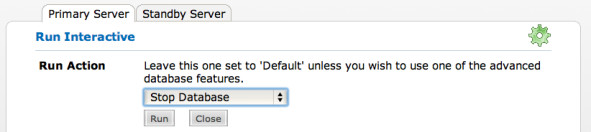
 To stop the standby database, choose the Standby Server tab.
12. To restart a database. This is the same as stopping a database first and then starting again:
 dbv_oraStartStop restart <DDC>
Where DDC is the name of the Dbvisit Database Configuration. In most cases this is the same as the database name. The DDC refers to the DDC file name which is in the form: dbv_DDC.env and contains the Dbvisit Standby settings for a particular primary and standby configuration.
Example:
dbv_oraStartStop restart w102n
======================================================
Dbvisit Standby Database technology
dbv_oraStartStop started on dbvisit11
======================================================
Shutting down regular Database w102n...
Regular Database w102n shutdown successfully.
Starting regular Database w102n...
Regular Database w102n started.
======================================================
dbv_oraStartStop ended on dbvisit11
======================================================
Where w102n is the name of the database.
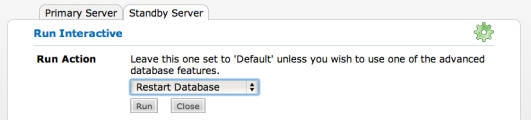
 Home > Run > Run Interactive > Primary Server tab > select Database from drop-down menu > select Restart Database from Run Action drop-down menu > Run
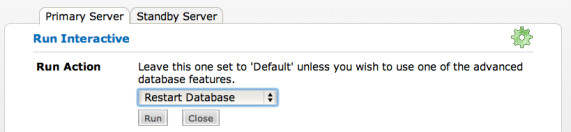
 To restart the standby database, choose the Standby Server tab.
13. To display the status of a database:
 dbv_oraStartStop status <DDC>
Where DDC is the name of the Dbvisit Database Configuration. In most cases this is the same as the database name. The DDC refers to the DDC file name which is in the form: dbv_DDC.env and contains the Dbvisit Standby settings for a particular primary and standby configuration.
For example:
dbv_oraStartStop status w102n
======================================================
Dbvisit Standby Database technology
dbv_oraStartStop started on dbvisit12
======================================================
Standby Database w102n on dbvisit12 is up.
======================================================
dbv_oraStartStop ended on dbvisit12
======================================================
Where w102n is the name of the database.
 Home > Run > Run Interactive > Primary Server tab > select Database from drop-down menu > select Database Status from Run Action drop-down menu > Run
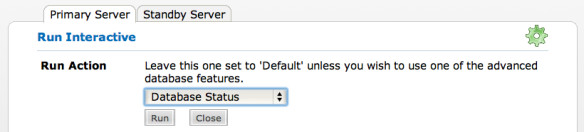
 To show the status of the standby database, choose the Standby Server tab.
14. To open a standby database in read-only mode use:
 dbv_oraStartStop open <DDC>
Where DDC is the name of the Dbvisit Database Configuration. In most cases this is the same as the database name. The DDC refers to the DDC file name which is in the form: dbv_DDC.env and contains the Dbvisit Standby settings for a particular primary and standby configuration.
For example to open a standby database:
dbv_oraStartStop open w102n
======================================================
Dbvisit Standby Database technology
dbv_oraStartStop started on dbvisit12
======================================================
Open standby Database w102n in READ ONLY mode.
Standby Database w102n opened in READ ONLY mode.
Log files cannot be applied to Database while in sync mode.
======================================================
dbv_oraStartStop ended on dbvisit12
======================================================
Where w102n is the name of the database.
 Home > Run > Run Interactive > Standby Server tab > select Database from drop-down menu > select Open Read-Only from Run Action drop-down menu > Run
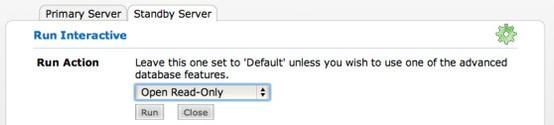
When the standby database is in READ ONLY mode, the log files cannot be applied to the standby database. This means the standby database will not be in synch with the primary database.
To return to normal standby database mode for applying log files, the standby database needs to be restarted:
 stop the database using dbv_oraStartStop stop <DDC>
 start the database using dbv_oraStartStop start <DDC>
Or:
3.  dbv_oraStartStop restart <DDC>
Or:
Activating standby database (failover)
In the event that the primary database is no longer available, the standby databases must be activated to become the new primary database. Dbvisit Standby provides a command to activate the standby database. For more information, please see the Failover - Activating the standby database section.
15. To activate a standby database:
 dbv_oraStartStop activate <DDC> [Yes]
Where DDC is the name of the Dbvisit Database Configuration. In most cases this is the same as the database name. The DDC refers to the DDC file name which is in the form: dbv_DDC.env and contains the Dbvisit Standby settings for a particular primary and standby configuration. Yes is optional and if specified then Dbvisit Standby will not prompt for confirmation to activate the standby database. This can be used for batch programming.
For example to activate a standby database:
=============================================================
Dbvisit Standby Database Technology
dbv_oraStartStop started on dbvisit12
=============================================================
Activating means this database will become a Primary Database.
It will no longer be a Standby Database for w102n on dbvisit12.
Activation cannot be reversed.
=>Activate Standby Database on dbvisit12? <Yes/No> [No]: y
Are you sure? <Yes/No> [No]: y
Activating now...
Activate Standby Database w102n...
Standby Database w102n activated.
Shutting down standby Database w102n...
Standby Database w102n shutdown successfully.
Starting activated Standby Database w102n...
Activated Standby Database w102n started.
Dbvisit Database configuration (DDC) file dbv_w120n.env has been updated and
variables have been reversed between primary and standby server.

SOURCE=dbvisit12 DESTINATION=dbvisit11.
Activation complete. Please ensure a backup of this Database is made.

If the Dbvisit process is to be reversed, then
Database on dbvisit11 will need to be rebuilt as a Standby Database.
=============================================================
dbv_oraStartStop ended on dbvisit12
=============================================================
Where w102n is the name of the database.
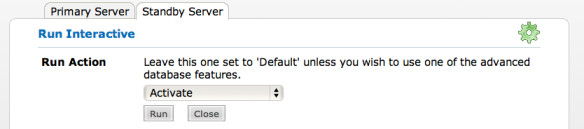
 Home > Run > Run Interactive > Standby Server tab > select Database from drop-down menu > select Activate from Run Action drop-down menu > Run
Graceful Switchover
16. To initial Graceful Switchover
 dbv_oraStartStop switchover <DDC> [unique_key]
Where DDC is the name of the Dbvisit Database Configuration. In most cases this is the same as the database name. The DDC refers to the DDC file name which is in the form: dbv_DDC.env and contains the Dbvisit Standby settings for a particular primary and standby configuration.unique_key is optional and can be supplied if Graceful Switchover is to be run in the background.This command must be issued on both the primary and the standby server.Both the primary and the standby database will be shutdown and restarted during the switchover. Please see the Graceful Switchover (role reversal) section for more information.
Example:
On the primary server start the Graceful Switchover procedure.
dbv_oraStartStop switchover dbvsun92
Where dbvsun92 is the name of the database
On the standby server start the Graceful Switchover procedure.
dbv_oraStartStop switchover dbvsun92
Where dbvsun92 is the name of the database
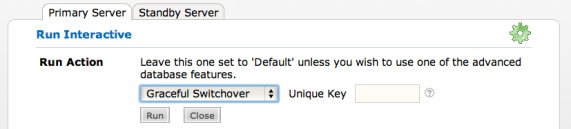
 Home > Run > Run Interactive > Primary Server tab > select Database from drop-down menu > select Graceful Switchover from Run Action drop-down menu > Run
Enter Unique Key. This can be any number, but it has to be the same number as entered on the Standby Server tab.
 Home > Run > Run Interactive > Standby Server tab > select Database from drop-down menu > select Graceful Switchover from Run Action drop-down menu > Run
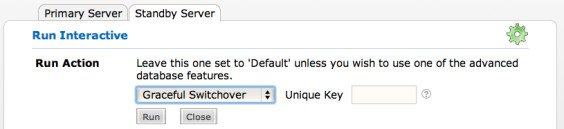
Enter Unique Key. This can be any number and it has to be the same number as entered on the Primary Server tab
.